14-39-58)
2014 Books/Source Books/Players Handbook/Part 1 (Ch 1-6)/Chapter 3/Chapter 3's Table of Contents
Every adventurer is a member of a class. Class broadly describes a character’s vocation, what special talents he or she possesses, and the tactics he or she is most likely to employ when exploring a dungeon, fighting monsters, or engaging in a tense negotiation.
Your character receives a number of benefits from your choice of class. Many of these benefits are class features — capabilities (including spellcasting) that set your character apart from members of other classes. You also gain a number of proficiencies: armor, weapons, skills, saving throws, and sometimes tools. Your proficiencies define many of the things your character can do particularly well, from using certain weapons to telling a convincing lie.
On your character sheet, record all the features that your class gives you at 1st level.
Level
Typically, a character starts at 1st level and advances in level by adventuring and gaining experience points (XP). A 1st-level character is inexperienced in the adventuring world, although he or she might have been a soldier or a pirate and done dangerous things before.
Starting off at 1st level marks your character’s entry into the adventuring life. If you’re already familiar with the game, or if you are joining an existing D&D campaign, your DM might decide to have you begin at a higher level, on the assumption that your character has already survived a few harrowing adventures.
Record your level on your character sheet. If you’re starting at a higher level, record the additional elements your class gives you for your levels past 1st. Also record your experience points. A 1st-level character has 0 XP. A higher-level character typically begins with the minimum amount of XP required to reach that level (Leveling a Character).
Each class description in the table below includes a section offering suggestions to quickly build a character of that class, including how to assign your highest ability scores.
Hit Points and Hit Dice
Your character’s hit points define how tough your character is in combat and other dangerous situations. Your hit points are determined by your Hit Dice (short for Hit Point Dice).
At 1st level, your character has 1 Hit Die, and the die type is determined by your class. You start with hit points equal to the highest roll of that die, as indicated in your class description. (You also add your Constitution modifier, which you’ll determine in step 3.) This is also your hit point maximum.
Record your character’s hit points on your character sheet. Also record the type of Hit Die your character uses and the number of Hit Dice you have. After you rest, you can spend Hit Dice to regain hit points (see Resting).
Proficiency Bonus
The table that appears in your class description shows your proficiency bonus, which is +2 for a 1st-level character. Your proficiency bonus applies to many of the numbers you’ll be recording on your character sheet:
- Attack rolls using weapons you’re proficient with
- Attack rolls with spells you cast
- Ability checks using skills you’re proficient in
- Ability checks using tools you’re proficient with
- Saving throws you’re proficient in
- Saving throw DCs for spells you cast (explained in each spellcasting class)
Your class determines your weapon proficiencies, your saving throw proficiencies, and some of your skill and tool proficiencies. Your background gives you additional skill and tool proficiencies, and some races give you more proficiencies. Be sure to note all of these proficiencies, as well as your proficiency bonus, on your character sheet.
Your proficiency bonus can’t be added to a single die roll or other number more than once. Occasionally, your proficiency bonus might be modified (doubled or halved, for example) before you apply it. If a circumstance suggests that your proficiency bonus applies more than once to the same roll or that it should be multiplied more than once, you nevertheless add it only once, multiply it only once, and halve it only once.
BUILDING BRUENOR, STEP 2
Bob imagines Bruenor charging into battle with an axe, one horn on his helmet broken off. He makes Bruenor a fighter and notes the fighter’s proficiencies and 1st-level class features on his character sheet.
As a 1st-level fighter, Bruenor has 1 Hit Die—a d10—and starts with hit points equal to 10 + his Constitution modifier. Bob notes this, and will record the final number after he determines Bruenor’s Constitution score (see step 3). Bob also notes the proficiency bonus for a 1st-level character, which is +2.
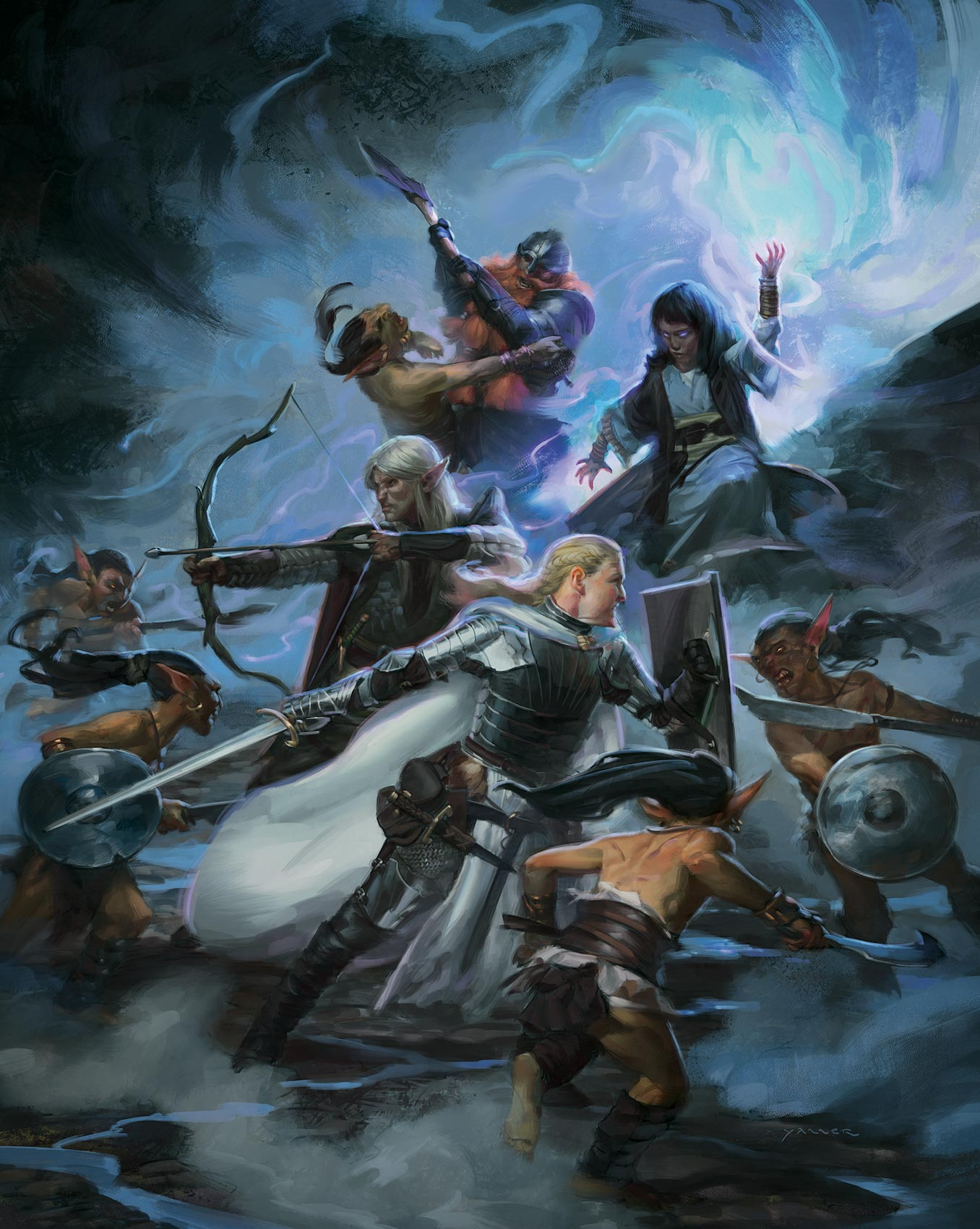
Adventurers are extraordinary people, driven by a thirst for excitement into a life that others would never dare lead. They are heroes, compelled to explore the dangerous places of the world and take on the challenges that lesser women and men can’t stand against.
Class is the primary definition of what your character can do. It’s more than a profession; it’s your character’s calling. Class shapes the way you think about the world and interact with it and your relationship with other people and powers in the multiverse. A fighter, for example, might view the world in pragmatic terms of strategy and maneuvering, and see themselves as just a pawn in a much larger game. A cleric, by contrast, might see themselves as a willing servant in a god’s unfolding plan or a conflict brewing among various deities. While the fighter has contacts in a mercenary company or army, the cleric might know a number of priests, paladins, and devotees who share his faith.
Your class gives you a variety of special features, such as a fighter’s mastery of weapons and armor, and a wizard’s spells. At low levels, your class gives you only two or three features, but as you advance in level you gain more and your existing features often improve. Each class entry in this chapter includes a table summarizing the benefits you gain at every level, and a detailed explanation of each one.
Adventurers sometimes advance in more than one class. A rogue might switch direction in life and swear the oath of a paladin. A barbarian might discover latent magical ability and dabble in the sorcerer class while continuing to advance as a barbarian. Elves are known to combine martial mastery with magical training and advance as fighters and wizards simultaneously. Optional rules for combining classes in this way, called Multiclassing.
Twelve classes — listed in the Classes table — are found in almost every D&D world and define the spectrum of typical adventurers.
Classes Summary
| Class | Description | Hit Die | Primary Ability | Saving Throw Proficiencies | Armor and Weapon Proficiencies |
|---|---|---|---|---|---|
| Barbarian | A fierce warrior who can enter a battle rage | d12 | Strength | Strength & Constitution | Light and medium armor, shields, simple and martial weapons |
| Bard | An inspiring magician whose power echoes the music of creation | d8 | Charisma | Dexterity & Charisma | Light armor, simple weapons, hand crossbows, longswords, rapiers, shortswords |
| Cleric | A priestly champion who wields divine magic in service of a higher power | d8 | Wisdom | Wisdom & Charisma | Light and medium armor, shields, simple weapons |
| Druid | A priest of the Old Faith, wielding the powers of nature — moonlight and plant growth, fire and lightning — and adopting animal forms | d8 | Wisdom | Intelligence & Wisdom | Light and medium armor (nonmetal), shields (nonmetal), clubs, daggers, darts, javelins, maces, quarterstaffs, scimitars, sickles, slings, spears |
| Fighter | A master of martial combat, skilled with a variety of weapons and armor | d10 | Strength or Dexterity | Strength & Constitution | All armor, shields, simple and martial weapons |
| Monk | A master of martial arts, harnessing the power of the body in pursuit of physical and spiritual perfection | d8 | Dexterity & Wisdom | Strength & Dexterity | Simple weapons, shortswords |
| Paladin | A holy warrior bound to a sacred oath | d10 | Strength & Charisma | Wisdom & Charisma | All armor, shields, simple and martial weapons |
| Ranger | A warrior who uses martial prowess and nature magic to combat threats on the edges of civilization | d10 | Dexterity & Wisdom | Strength & Dexterity | Light and medium armor, shields, simple and martial weapons |
| Rogue | A scoundrel who uses stealth and trickery to overcome obstacles and enemies | d8 | Dexterity | Dexterity & Intelligence | Light armor, simple weapons, hand crossbows, longswords, rapiers, shortswords |
| Sorcerer | A spellcaster who draws on inherent magic from a gift or bloodline | d6 | Charisma | Constitution & Charisma | Daggers, darts, slings, quarterstaffs, light crossbows |
| Warlock | A wielder of magic that is derived from a bargain with an extraplanar entity | d8 | Charisma | Wisdom & Charisma | Light armor, simple weapons |
| Wizard | A scholarly magic-user capable of manipulating the structures of reality | d6 | Intelligence | Intelligence & Wisdom | Daggers, darts, slings, quarterstaffs, light crossbows |