Creature Size
Each creature takes up a different amount of space. The Size Categories table shows how much space a creature of a particular size controls in combat. Objects sometimes use the same size categories.
.png)
Size Categories
| Size | Space |
|---|---|
| Tiny | 2 ½ by 2 ½ ft. |
| Small | 5 by 5 ft. |
| Medium | 5 by 5 ft. |
| Large | 10 by 10 ft. |
| Huge | 15 by 15 ft. |
| Gargantuan | 20 by 20 ft. or larger |
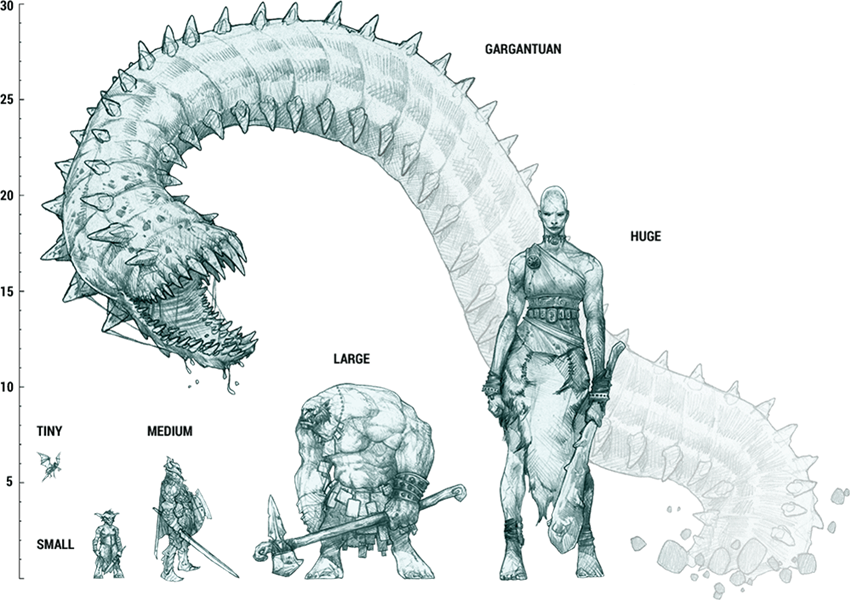 |
Space
A creature’s space is the area in feet that it effectively controls in combat, not an expression of its physical dimensions. A typical Medium creature isn’t 5 feet wide, for example, but it does control a space that wide. If a Medium hobgoblin stands in a 5-foot-wide doorway, other creatures can’t get through unless the hobgoblin lets them.
A creature’s space also reflects the area it needs to fight effectively. For that reason, there’s a limit to the number of creatures that can surround another creature in combat. Assuming Medium combatants, eight creatures can fit in a 5-foot radius around another one.
Because larger creatures take up more space, fewer of them can surround a creature. If four Large creatures crowd around a Medium or smaller one, there’s little room for anyone else. In contrast, as many as twenty Medium creatures can surround a Gargantuan one.
Squeezing into a Smaller Space
A creature can squeeze through a space that is large enough for a creature one size smaller than it. Thus, a Large creature can squeeze through a passage that’s only 5 feet wide. While squeezing through a space, a creature must spend 1 extra foot for every foot it moves there, and it has disadvantage on attack rolls and Dexterity saving throws. Attack rolls against the creature have advantage while it’s in the smaller space.
If you play out a combat using a square grid and miniatures or other tokens, follow these rules.
Squares: Each square on the grid represents 5 feet.
Speed: Rather than moving foot by foot, move square by square on the grid. This means you use your speed in 5-foot segments. This is particularly easy if you translate your speed into squares by dividing the speed by 5. For example, a speed of 30 feet translates into a speed of 6 squares.
If you use a grid often, consider writing your speed in squares on your character sheet.
Entering a Square: To enter a square, you must have at least 1 square of movement left, even if the square is diagonally adjacent to the square you’re in. (The rule for diagonal movement sacrifices realism for the sake of smooth play. The optional rule for diagonals in using miniatures provides guidance on using a more realistic approach.
If a square costs extra movement, as a square of difficult terrain does, you must have enough movement left to pay for entering it. For example, you must have at least 2 squares of movement left to enter a square of difficult terrain.
Corners: Diagonal movement can’t cross the corner of a wall, large tree, or other terrain feature that fills its space.
Ranges: To determine the range on a grid between two things—whether creatures or objects—start counting squares from a square adjacent to one of them and stop counting in the space of the other one. Count by the shortest route.